With a week or so to go before Mark & the kids headed off to Malaga on 16th December, and then to Morocco via Gibraltar, London started to get some of its infamous cold, foggy and frosty days with the temperature staying below zero for days on end.


The same time last year saw flights being cancelled as icy weather shut down airports, so we were pleased when the forecast for the weekend of 16th was for much milder days rocketing up to 10 degrees. Mark, Aisha & William headed off early on the first Sunday of the Christmas holidays, rugged up for London


but ready to strip down for the sunshine and outdoor tapas bars of .....
................................................................Malaga
................................................................Malaga
The street flower beds were filled with poinsettias which are normally indoor plants here. At the tapas bars William was very brave and ate a mushroom, a prawn, some eggplant and even a WHOLE fried anchovy - head, eyes and all ! What a hero !
With a history of almost 3,000 years spanning Phoenician, Roman, Arabic and Christian eras, Malaga claims to be one of the world's oldest cities. Founded by the Phoenicians as Malaka in about 770 BC, it was under the control of Ancient Carthage from the 6th century BC. After the various Punic wars between Rome and Carthage it then came under Roman rule from 218 BC. After the fall of the empire it eventually came under Islamic domination as Mālaqah for 800 years. In 1487 it returned to Christian rule following the Reconquista (when, in medieval times, Muslim control of Spain was overthrown).


 |
| Will ! Stop it !!! |
We had the Malaga Cathedral as the view from our hotel window. Also known as the Church of the Enunciation, the cathedral is a renaissance church built from 1528 on the site of a mosque and within the limits of the old Moorish walls. The cathedral was partly destroyed by an earthquake in 1680 and was finally completed in 1782.
The view from the hotel window.


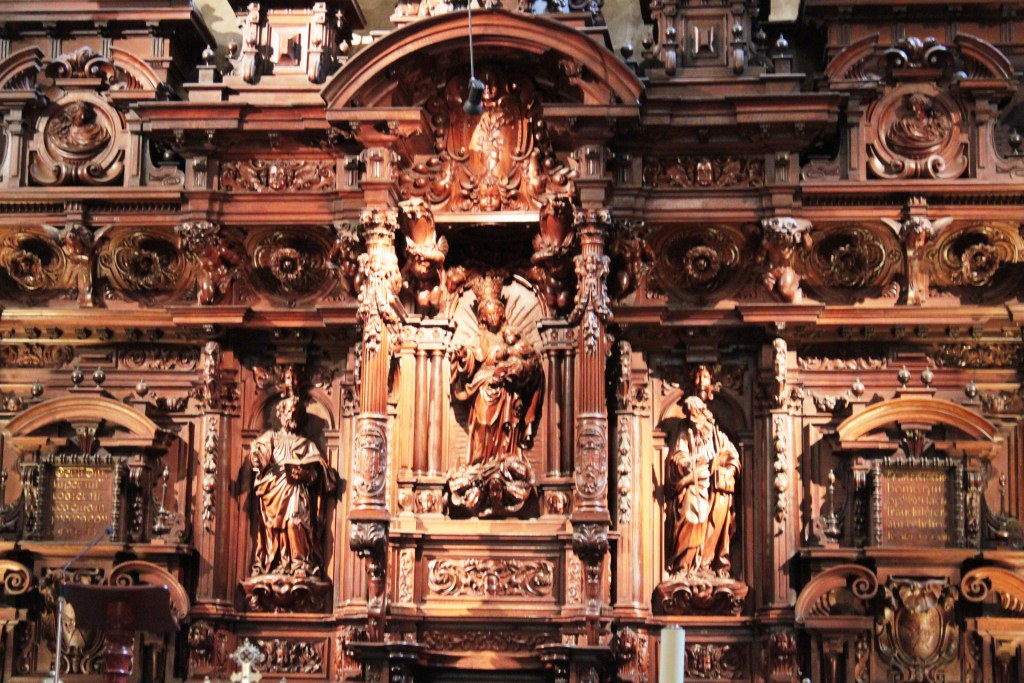
The interior was spectacular with soaring chunky columns leading to impressive moulded ceilings. The choirs stalls were amazing, intricately and beautifully carved from dark tropical hardwoods. Amongst all the usual gilded Spanish chapel statuary was an intricate nativity scene. In Malaga & Gibraltar we saw many similar nativity scenes, some with moving parts - see the video below. There was also an.....'interesting' likeness of the baby Jesus in one of the side chapels.


 |
| The choir stalls. |
 |
| Now this is a nativity scene ! |
 |
| Jesus..... ? Looks like he is waiting for a beer. |
Not far away was the Malaga bullring.


La Malagueta was built in 1874. The first fight took place two years later and they continue today. In 1976 the site was declared an Historic Artistic Monument and in 1981, it was declared an Official Site of Cultural Interest. We did not expect to come across any bull fights while we were in Malaga but to our surprise we did. We could not help but be drawn in by the hypnotic intricacy of the matador's dance like moves. Below is a shortened version of the fight. For the squeamish, stop the video as you hear the crowd calling out 'Bruto'.
The Christmas lights on the main streets of Malaga were nicely done and it was great to promenade along what is reported to be one of the loveliest streets in all of Spain, looking at the various performers, having ice creams and catching glimpses of the Cathedral.


The kids also had their names done, very quickly, in amazing stylised Chinese calligraphy.
 |
| Yummmm, dark Chocolate ice cream ! |

 |
| BRUTO ! |
After two nights in Malaga we caught the bus to La linea de la Concepcion, the Spanish town on the border with Gibraltar. We had the afternoon in Gibraltar and, after booking into our hotel - again with a great view, we walked into British territory just 10 minutes away. Look at the photo below on the right and follow the slope of the rock down to the right to behind the buildings. The small bump further on are the Atlas mountains in Morocco !
 |
| The view from our hotel. |

The view on top of the rock looking back into Spain, while Morocco beckons just 14 kms across the water.

 |
| The Atlas Mountains of Morocco just 14 kms away. |
The Barbary apes.


Gibraltar was a bit strange. The border was one of the oddest that Mark has ever crossed - and he has crossed a few. The security and immigration checks both leaving Spain and entering British territory might be described as cursory at best. Just 20 metres inside the border gates, lines of Spaniards pushed and shoved to get duty free cigarettes to then take back over the border to sell. The main street of Gibraltar had a feel of the 'wild west' about it. British pubs, a Marks & Spencer's, shops selling very cheap alcohol (duty free + no VAT) along with boy racers in revved up cars. A strange place indeed.
On the way back through town we found a small but very well kept graveyard for sailors killed in the battle of Trafalgar. Yet another occasion of history jumping up and staring us in the face.


The runway for the international airport in Gibraltar cuts straight across the main road. The kids took the opportunity for a rest on the runway.

After a night in La linea de la Concepcion we caught a bus to Algeciras for the ferry across the straits. In the summer months it is possible to sail to Morocco from Gibraltar but not at this time of the year. It was all very straight forward however and we spent a few hours sitting around at the port waiting for the ferry to load. Then, with just a handful of foot and car passengers, we 'set sail' for the north African coast and Tangier, just 1 hour or so so away.
Morocco.
Tangier.
Tangier had a reputation as being pretty rough and a bit seedy. We found that while it did have a bit of the edgy feel we loved about Naples, it was no problem. We got to our hotel by about 2 pm then headed out to have a look around. We couldn't avoid a 'helpful' young man who did a pretty good job of showing us around. We found that Tangier has some snazzy new parts and some run down old parts. We found some WWII graves, that the Range Rover Evoque had made its way there and that William really liked the old style radios in our hotel room.


 |
| Sing along with Bill.
We were eventually able to disengage ourselves from our guide and make our own way around the old city of Tangier later that evening. In doing so we found a very good kebab place. We sat on a low wall eating to the sounds of Cheb Khaled, our favourite Arabic singer, and watching the passing parade. We liked the kebabs so much Aisha & Mark decided to send William back for more. To appropriately mournful music, he braved the traffic, crossed the road (seemed to be almost hit by a car) and ordered the kebabs. On the way back he decided to cross with the locals rather than on his own. Well done Will! Have a look at the video below of his daring bravery.
|

Chefchaouen.
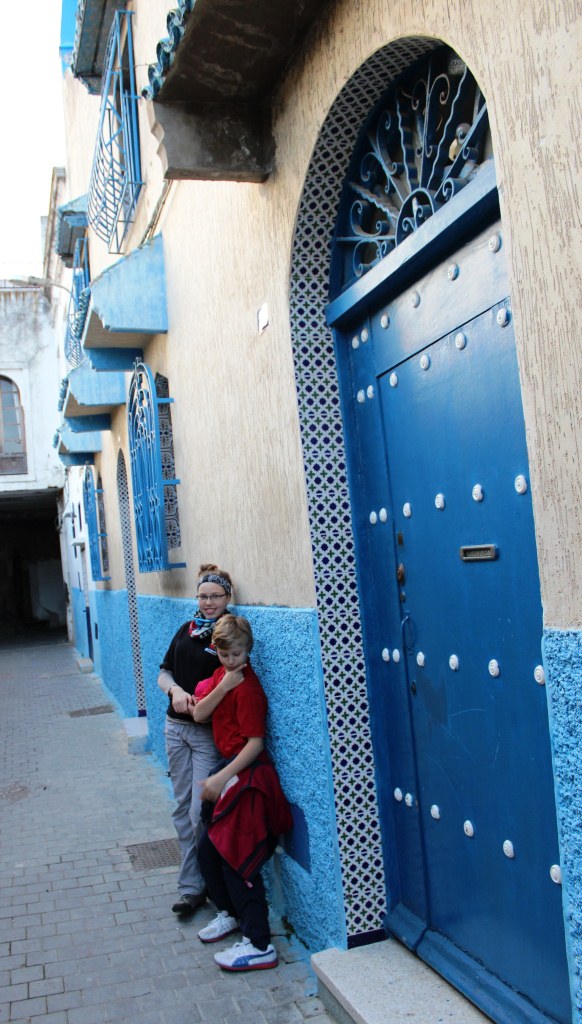
The next day, 20th December, was the first of several long bus trips. Again it was all very easy but involved a fair bit of waiting around and then lots of sitting on a fairly comfortable bus for the 3 hour journey to Chefchaouen (shefshawoon) a village at the foot of the Rif mountain range. It was one of the main concentrations of Moriscos (Spanish Muslims who converted to Christianity in order to stay in Spain or Portugal) and Jews who sought refuge in this mountainous city after the Spanish Reconquista. In modern times Chefchaouen is known for its cool climate, use of blue on its buildings and still being relatively authentic and not overly commercialised. We wondered if we would have snow and were expecting weather similar to London. In fact we had very mild weather with stunning blue skies. Sally would have loved it but was due to join us in Fez three days later. Chef is such a photogenic place that we could easily fill this post with pictures of nowhere else.
 |
| The view from our rooftop terrace. |


 |
| Looking down on the main square. |
Not only were the surroundings beautiful but the village itself was amazing.


Moroccan restaurants can be highly decorated. We had an excellent lamb tagine at this one.


Our hotel was small but was located in a good position high on the hill giving good views across the valley.


The narrow alleyways of the old town constantly threw up endless 'photo opportunities'.


Aisha had her first of several henna tattoos here.


After two nights in Chefchaouen we caught a bus to Fez where we were hoping to meet up with Sally at the railway station. She had flown in to Casablanca at midnight the night before. By the time we all met up on the afternoon of the 22nd, Sally had successfully taxied her way from the airport in Casablanca to the pre-booked hotel then toured Casablanca the next day as Mark & the kids were winding their way down the hills out of Chefchaouen.
Casablanca.
Sally reports...Casablanca is the economic hub of Morocco; a big city with lots of building going on and all the signs of a place that is on the move. My Arabic language came back to me sufficiently to be able to successfully negotiate my way to the hotel around 1am in the morning and to not get fleeced by the local taxis! The next morning I took a cab to the Hassan II Mosque, one of few in the country that permits non-Muslims to enter. It is the largest in the country and the 7th largest in the world. Its minaret is the world's tallest at 210 metres, or 60 stories high and is topped by a laser, the light from which points towards Mecca. The mosque stands on a promontory looking out to the Atlantic Ocean and the sea bed is visible through the glass floor of the building's hall. The walls are of hand-crafted marble and even though the roof is incredibly large and ornately decorated, it can retract, making it open air for when there are big crowds there. Indeed the mosque can hold a total of 105,000 people, 25,000 inside the mosque hall and another 80,000 on the grounds outside.
 |
| feeling short below such a tall minaret! |

 |
| The retractable ceiling |
 |
| Atlantic coast and sunshine |
 |
| A city that is growing fast |
I had thought of trying to get to see Rick's Cafe, a recreation of the mythical one in Bogart and Bergman's film "Casablanca", but time ran out. I reassured myself that it had only been in a film and that indeed the film was shot at Warner Bros Studos in Burbank! So, after making my way to the railway station, I caught the train to Fez - a straightforward 4 hour trip which gave me a good opportunity to take in the scenery as the train wound its way up the Middle Atlas mountains.
Fez
Fez is Morocco's second largest city. It has been called the Mecca of the west and the Athens of Africa. Here we checked into our first fancy Riad. Over the last 15 years or so, hundreds of these traditional open courtyard style Moroccan houses have been converted into hotels. Very similar to old Damascene houses, their high ceilings are best suited to the heat of summer. We found our room impressive, but chilly. Similarly the open courtyard where meals were served would have been great to hang out in during summer but in December .....
 |

The main Fez medina is a UNESCO World Heritage site as well as possibly being the world's largest contiguous car-free urban area. The city has been called the "Mecca of the West" and the "Athens of Africa". The Medina is very extensive with narrow alleyways that twist and turn back on themselves. Mostly covered and with a myriad of narrow alleyways, we did a good job of getting ourselves lost many times. Walking through them, Sally and Mark were reminded very much of the Souq Al-Hamidiyah in Damascus. In fact there were many shops selling the in-laid boxes and ornaments from Damascus. When they were leaving Chefchaouen, Mark got talking with a young American at the bus station who said he found Fez to be a real hassle with rude shopkeepers and endless 'guides' and that Marrakech was much better. Perhaps it was because we were so obviously a family group, we found Fez no problem at all. Whenever we became lost we asked the shopkeepers who were happy to help.


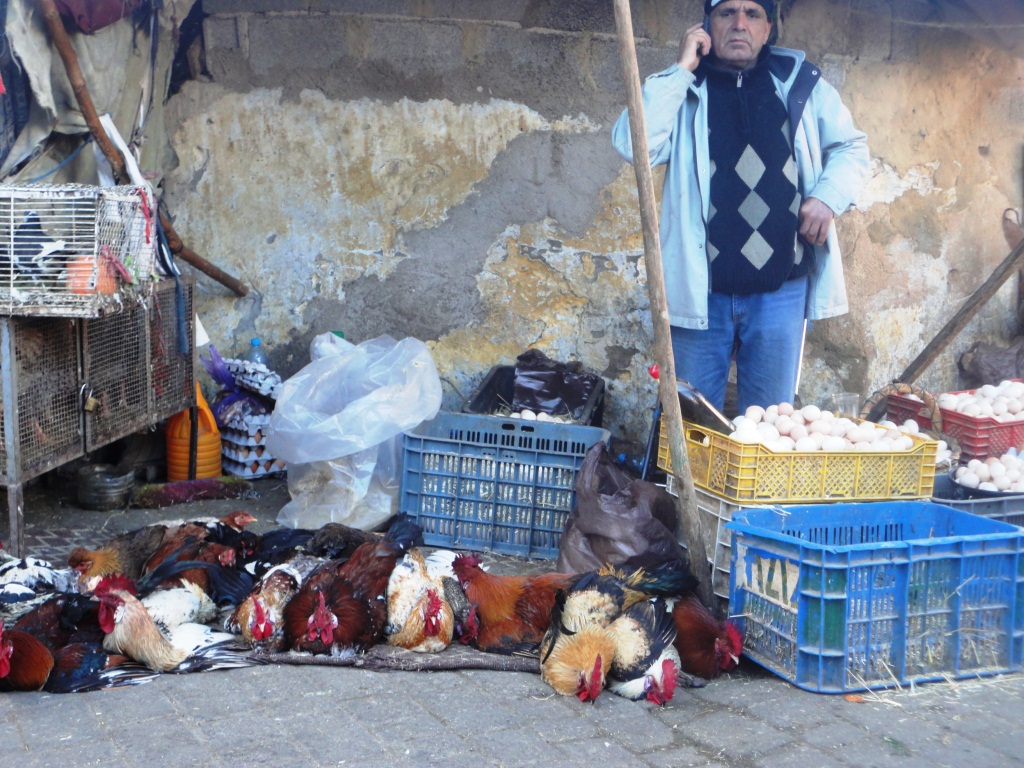
The shops were grouped together in streets - the fabric street, the bead street, chickens and eggs. Shoes were very common.

Aisha got talking, in a mixture of English, French and some Spanish, to a young girl running a small jewellery shop for her mother and later found an impressive wedding throne. William tried his hand at buying himself some local slippers, while Sally went mad in a bead shop!


We found a nod to Christmas and a man in a lock and key shop little bigger than a cupboard.


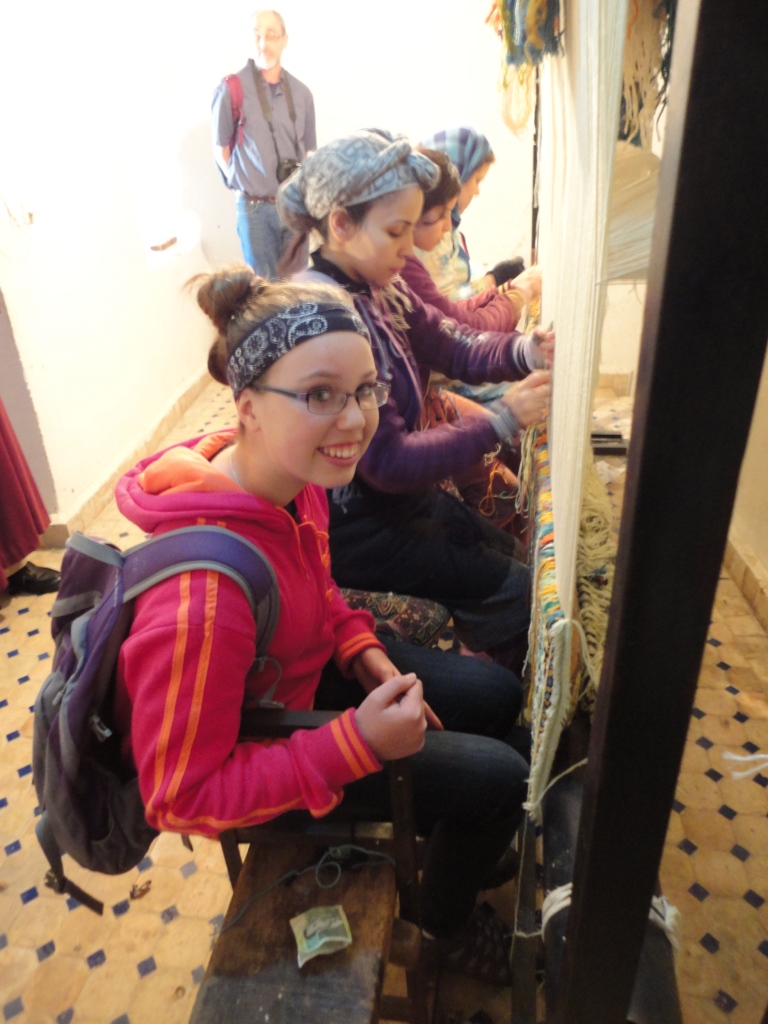
During one of our forays into the souq we were gently assisted by a very amiable older gentlman who took us to a carpet shop...... While we knew full well what was likely to happen later (the hard sell) we decided nonetheless to go with him. Having a house full of carpets after two years living in Syria in the 90s we didn't really see anything that we felt we wanted to buy. It was great though to get to re-live the carpet shop experience and take in those wonderful carpet smells. As part of the guiding we saw some carpet weaving which the kids were able to have a go at. In the end there was only a fairly gentle attempt at selling, which we were able to resist.


We followed our noses to find the tanneries.


While we were't allowed into any of the mosques, the old madressas or Koran schools were not off limits. The Al-Qarawiyyin madrassa was founded in AD 859 by Fatima al-Fihri. It is the oldest continuously functioning
madrassa in the world and one of several that lay claim to being the world's oldest university.
The calligraphic carved walls were stunning.


Aisha tried to do a new cool facebook profile photo...... but failed.


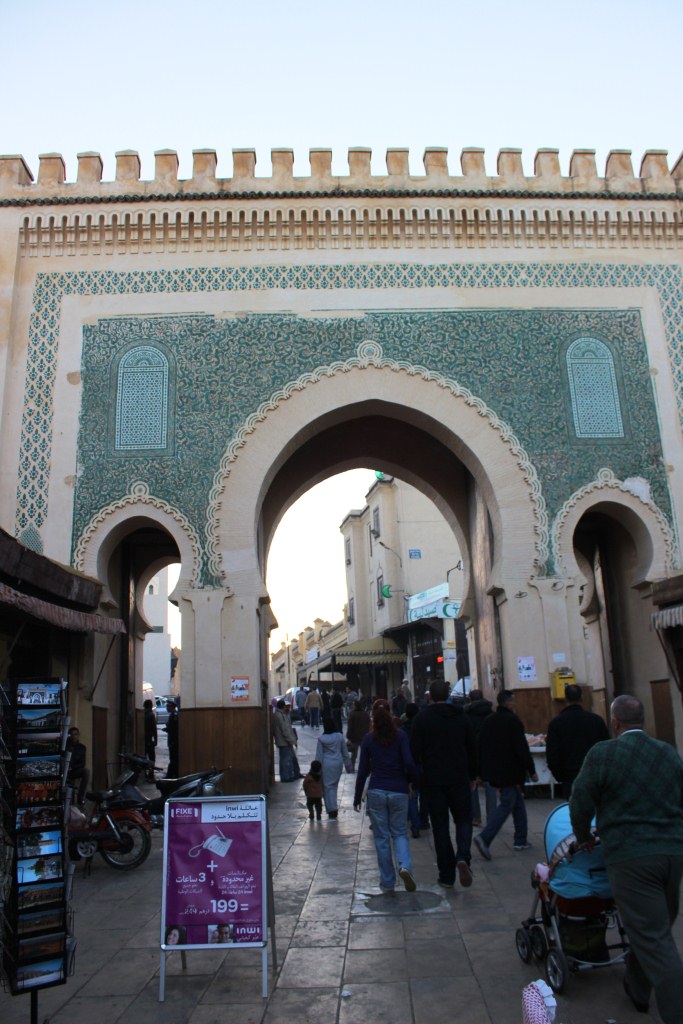
We had a meal at one end of the Souq near the impressive blue Bab Bou Jeloud and watched the world go by.


 |
| Camel burger ! Really. |
 |
| Sally was happy ! |
 |
| A Fezmas tree. |
 |
| Aisha, Sally & William. |
The view from the roof of the cafe.


After we finished our very late lunch/early dinner Sally spotted a notice for a Moroccan music concert to be held at the cafe that night. We decided to stay to see it and were very glad we did. Click on the video to have a look at some of the fantastic traditional music and dancing from locals, the ex-pat British owner as well as Aisha and William.
While we were unable to go into any mosques in Morocco (except Sally in Casablanca), we were able to visit some Jewish cemeteries and synagogues in Fez that are still open and functioning. Large numbers of Jews have been in Morocco after fleeing Spain and Portugal during the Spanish Reconquista (from the 700s to around 1492). At its peak in the 1940s, Morocco's Jewish population exceeded 250,000. Today, around 5,000 Jews remain in Morocco, while in Israel they constitute the second-largest Jewish community, after the Russian Jews.


The Jewish community, though small now, has left an enduring mark on the style of houses in the areas they lived. The typical Muslim/Arab style house has an inner courtyard, while the Jewish style houses have a verandah on the front. These houses still remain in the old Jewish districts of Fez.


While we were in the Mellah district we saw some shops adorned with what looked almost like Christmas decorations, but were told they were for the big New Years celebrations coming up.


We enjoyed mild, sunny and dry weather for all of our trip to Morocco - except for Christmas day. We had booked a Christmas day trip out to Volubilis, a partly excavated Roman city about 1.5 hours drive from Fez. Driving out to Volubilis it was obvious how fertile the land was. We passed one dam which reminded us very much of Lake Jindabyne in southern New South Wales. Our guide told us that until 10 years ago the lake had been drying out and, as with Jindabyne, the old town which had been abandoned as the dam levels rose, started to re-emerge. The last 10 years have seen a return to above average rainfall and the town has again disappeared beneath the waters.
 |
| Just like Jindabyne in NSW, Australia. |
Volubilis was developed as a Phoenician / Carthaginian settlement from the 3rd century BC. From the 1st century AD, under Roman rule, it grew rapidly and became prosperous from olive production. At its height in the 2nd century it had many fine public buildings, including a basilica, temple and triumphal arch as well as many fine town-houses with large mosaic floors, all protected by a 2.6 km circuit of walls.
In 285 AD the town fell to local tribesmen and, owing to its remoteness as one of the farthest outposts of the Empire, was never retaken by the Romans. Over the next 700 years it became a Christian community, then Islamic. By the 11th century Volubilis had been abandoned in favour of the nearby new town of Moulay Idriss Zerhoun.
On our only organised trip, we woke to an overcast cool Christmas day which, by the time we arrived at Volubilis, saw drizzle turn eventually to significant rain. While we had an umbrella, the rain became heavier and heavier, the dirt paths of the ruins soon turned to small rivers and the mosaics that Volubilis is known for slowly disappeared beneath great puddles.


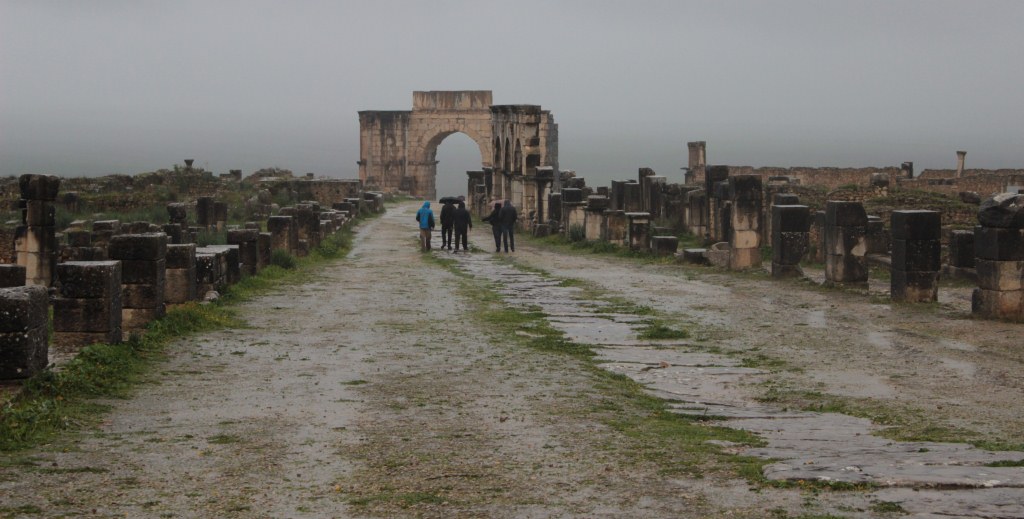

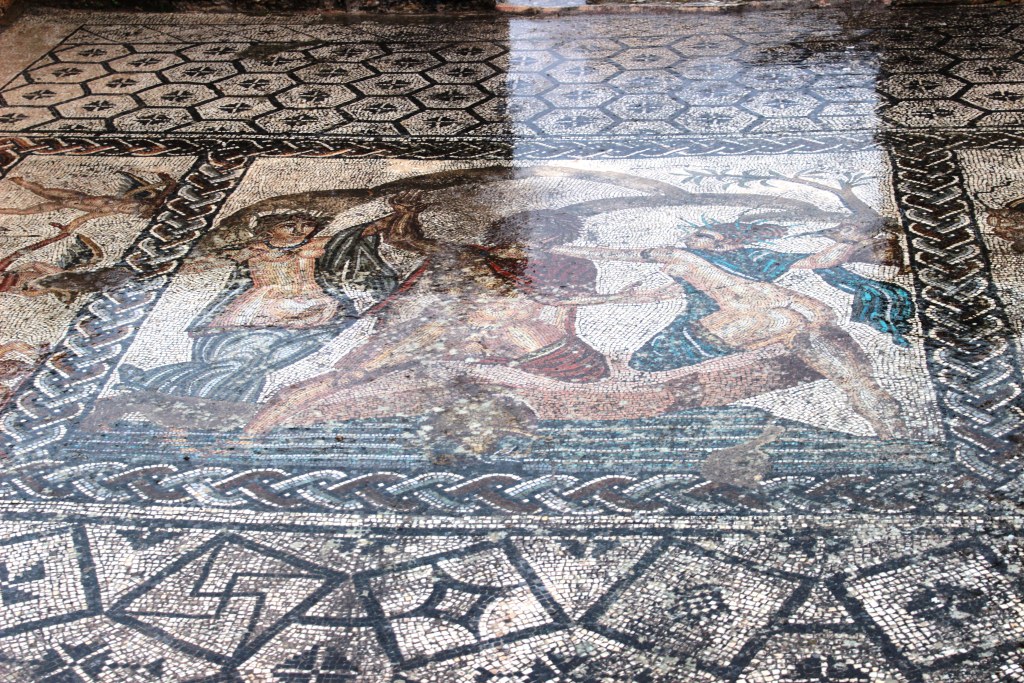

After only 30 minutes were were all totally sodden and very cold. We cut the Volubilis visit short and continued on the pre-determined tour route to Moulay Idris where we were supposed to see the very important shrine, but the valley view was fogged in and the roads gushing. We then went on to see the granaries and royal stables built by Moulay Ismail at Meknes in late 1600s to hold 12,000 horses and enough grain to feed them for up to 20 years. The granaries were built on a reservoir which supplied water that ran through a canal ran fresh water through the stables constantly. There was impressive technology behind the storage of such large amounts of grain which needed to be kept cool to keep from rotting. Apart from having thick walls, the roof of the granaries apparentlyhad a living green roof - perhaps a bit like the grass covering of Australia's Parliament house. As well water from the reservoir below was forced through ducts in the floor to act as under floor cooling. An earthquake during the eighteenth century left most of the stables in ruins.


In the end though we cut short the day trip and headed back to Fez to dry out in our hotel room. As we drove back to town, we discovered that the biodata pages on Mark and Willian's passports had been ruined and that the camera was not working.....We put the kids into hot showers and bed and Mark spent the rest of the afternoon ironing clothes dry while our shoes ended up stacked on top of one of the tall wardrobes to dry. Later in the afternoon (when blue sky had reappeared :-(, Sally and Aisha, who only had one pair of shoes each, went down to the souq hoping to find a cheap pair of shoes each to make do. They ended up finding a Moroccan shop that sold (presumably) new but end of line brand name shoes from Europe. They joined the locals digging through great mounds of shoes and emerged a while later with a pair of black leather fluffy lined ankle boots and a pair of Camper summer shoes for Aisha, while Sally found a pair of Ecco black leather ankle boots. All for 25 Euro - a great Christmas present which went some way to making up for the drenched morning and made our shoe mad girls very happy!


We were scheduled to leave for Marrakesh the next day. Fortunately, thanks to Mark's efforts, almost everything was dry and the weather returned to sunny and clear. The van we took to the train station didn't quite fit all the passengers so Will sat in the back with the luggage. Amazing how your usual safety concerns tend to evaporate overseas.


The train journey was 7.5 hours long but comfortable enough. We passed endless eucalyptus plantations which at times looked exactly like swathes of Australian bush. While it wasn't quite the Marrakesh Express from the song, (that goes from Tangier), it was pretty cool to be on a Moroccan train!
 |
| All aboard! |
 |
| ...take us to Marrakech.... |
 |
| Eucalyptus plantations. |
We arrived at Marrakech in the early evening and were collected by our Riad. This time we had two separate rooms on the top floor of the building. Like the Fez riad they were fancy with perhaps more style than substance.


 |
| Aisha's 'special Ted' claimed his spot early. |
Unlike Fez, the Marrakech souks are much wider and less twisting. Again the anticipated hassle did not materialise as we found ourselves wandering the alleyways without any offers of 'guides'.


 |
| Will buys sugar cane juice. |
We headed straight for the main square, Jemma al Fna, and found the variety of snake charmers, musicians and street entertainers eager to catch our attention. It has to be said that the treatment of the animals was not good and we resisted engaging with the handlers until the last day when we felt we had to have the obligatory snake photos. We would come back to the square many times over the next three days. We found that early evening was the best time to be there when the food stalls started setting up and the crowds moved in to be entertained.


Eating out, Jemaa el Fna style.


 |
| Aicha & Aisha. |
The square has been listed a a world heritage site of cultural significance. The souks and the square haven't changed a lot since the 1920s when these photos were taken.


Having arrived in Marrakech in 1919, the French artist Jaques Majorelle bought land on what was then the outskirts of the city. He designed and built a garden which was then opened to the public in 1947 as Jardin Majorelle. His use of cobalt blue throughout the garden, inspired by the blues used in Moroccan tiles and in the costumes of the Berber people, led to the colour being named Majorelle Blue after him. The garden is largely cacti and bamboo and is quite amazing. The land and gardens were bought by Yves Saint Laurent and Pierre Berge in 1980. Laurent died in 2008 and his ashes are scattered in the garden. In 2011 a Berber Museum was opened showcasing his collections of Berber costumes and, in particular, a stunningly presented display of beautiful Berber jewellery.


As with Fez, we were unable to go into any Mosques but the old Koranic schools were open to us.


 |
| A bit too much ??? |

The Souq had lots of little back streets to explore.
 |
| Will goes Berber in the Dyers' Market |




 |
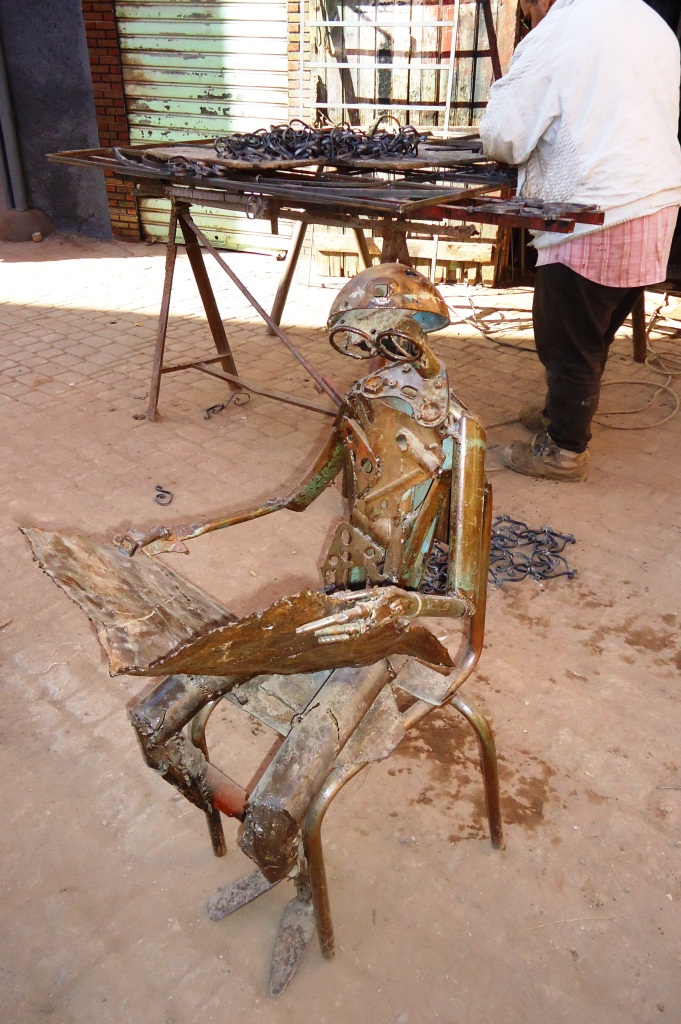
| Tinky Winky or DumbleDad? |

The El Badi Palace. El Badi means the incomparable and it must have been. Financed by a ransom paid by Portugal after the Battle of Three Kings it was commissioned by the Saadian Sultan Ahmad al-Mansur in 1578.
The original building is thought to have consisted of 360 rooms, a courtyard of 135 m by 110 m and a pool of 90 m by 20 m, richly decorated with Italian marble and large amounts of gold imported from Sudan. It also has a small, underground, tunnel-like jail with about four cells where the king kept his prisoners.


The last afternoon in the souq turned out to be eventful. While
we had been fairly careful with what we ate we were not paranoid. Before
leaving for the trip, Mark had told the kids he expected that somewhere along
the way some of us might get sick. Well......
As we were walking through the souq, slowly on our way back to the hotel, Aisha announced she felt a bit sick. Minutes later and with very little warning she deposited the lunch we had not long finished onto the middle of the cobbled road. Spectacularly. Several times. The local shopkeepers moved in quickly with offers of somewhere to sit, a bottle of water and concern. As we were dealing with Aisha, someone else was cleaning up the street. No-one made a fuss. We were able to express our gratitude and started to make our way back to the hotel. Aisha was able to contain herself but William started to complain of a sore stomach and a need to go to the toilet. Quickly !
We made it back to the hotel in just time. To cut a long story short (as we like to do...) that last evening in Morocco was spent with William in with Mark and Sally in with Aisha. William was very good humoured about his new best friend - the toilet. Aisha was in more pain and spent a lot of time vomiting.
Needless to say Mark & Sally were concerned about the amount of fluids being ejected form the kids' bodies. We were also relieved this was the last night rather than the first and that no long bus or train trips were looming, We were a little concerned though about how we would get the kids to the airport mid the next morning and then how the flight would go. Thankfully, by the morning, both kids were somewhat better. Nothing left inside either of them we thought. The trip to the airport was short and the flight was uneventful. As mentioned in the New Year's post, we got back to East Finchley to find Santa had been ! click here. The kids were fine after a good night's sleep. Mark however later came down with a combination of both William's and Aisha's lurgy just in time for the fireworks at Parliament Hill on New Year's eve. Sally remained unscathed.
Well done for getting to the end of this very long post. We had a great time in Morocco and were very happy with the kids' first exposure to African/ Arabic inspired Muslim culture.
As this post is published, on 16th February, Mark & the kids are heading off to Berlin for week before returning to London for a day before heading off on the school's ski trip to France for a week.
Sally will be making the most of the weekends without them by going to Norwich on the first weekend then somewhere else the next. Thanks for the email comments on the blog, it is nice to know it is read.
take care all of you !!


