Monday, 26 November 2012

A monster, Rio, Brownsea, Durdle Door, Brighton & Baghdad.

The end of the Paralympics marked the end of the whole London 2012 celebration and the beginnings of the hand over to Rio 2016. As part of the Lord Mayor of London's celebrations there was a Rio style street carnival. Unlike the feather celebration mentioned in an earlier post, we did not stumble across this one but went specifically to see it. Our young friend Julian had been up visiting for the Olympics and we combined seeing him off with visiting the local Cherry Tree Wood Fair, where Aisha made a vegie monster - as you do. We ended up at Potters' Field again and browsing some of the markets set up there before heading down to the embankment to see the parade.


Walking across the Millennium Bridge we found what looked like 'The skateboards' graveyard'. 


The carnival started late and the warm day quickly turned to a fairly cool night - which would have been challenging for some of the performers. We didn't stay until the end but did see a large part of the parade as it wound it's way across the Waterloo Bridge along the Thames and up to Millennium Bridge.


Brownsea island.
In August we went to Brownsea island to pay homage to Lord Baden Powell, the founder of Scouts and, indirectly, Girl Guides. Both the kids have heard stories abut BrownSea for many years in Scouts and Guides back in Australia. As part of a trip down to Osmington we decided to make the relatively short journey across to the island, the largest of eight islands in Poole Harbour off the Dorset coast. 

Brownsea has quite a significant history beyond its more widely known scouting connection. The earliest recorded inhabitants date from the 9th century when a small chapel and hermitage were built by monks from Cerne Abbey near Dorchester. In 1015, no less a figure than King Canute led a Viking raid to the harbour and used Brownsea as a base to sack nearby Abbeys. Later, after his invasion of England, William the Conqueror gave the island as part of the local area to his half-brother, Robert de Mortain.

Following the dissolution of the monasteries, control of the island passed to the Crown. Recognising the strategic importance of the island in guarding the narrow entrance to the expanding port of Poole, Henry VIII had the island fortified in 1547. In 1576, his daughter, then Queen Elizabeth I, made a gift of Brownsea to one of her court favourites, Sir Christopher Hatton.

The island eventually ended up in private hands & served various purposes, including an unsuccessful attempt at establishing a fine china pottery there using the local clay. During WWII large flares were placed on the western end of the island to mislead Luftwaffe bombers away from the port of Poole. This saved Poole and Bournemouth from 1,000 tonnes of German bombs but resulted in the nearby deserted village of Maryland being destroyed. 

Scouting on the island began on 1st August 1907. The then 50 year old Robert Stephenson Smyth Baden-Powell, 1st Baron Baden-Powell, Bt, OM, GCMG, GCVO, KCB held the first week long experimental scout camp on the island. 22 boys from differing social backgrounds took part in activities such as camping, observation, woodcraft, chivalry, lifesaving and patriotism. With the success of this camp, Powell was spurred on to publish 'Scouting for Boys' in 1908 and arrange further camps. The international scouting movement grew rapidly as a result. In the 1934 however, all public access on the island was forbidden by the island's owner, after a wild fire caused devastation. Burning for a week, much of the island was reduced to ashes. After the death of the owner, the island was taken over by the National Trust and a permanent Scout camp site was opened in 1963 by Olave Baden-Powell.




Brownsea is also one of the few places left in The UK where native red squirrels still live, having been overrun by the American grey squirrel - the ones that eat Mark's tulip bulbs.
Who on earth could possibly call them 'rats with fluffy tails' ???
Piddle.
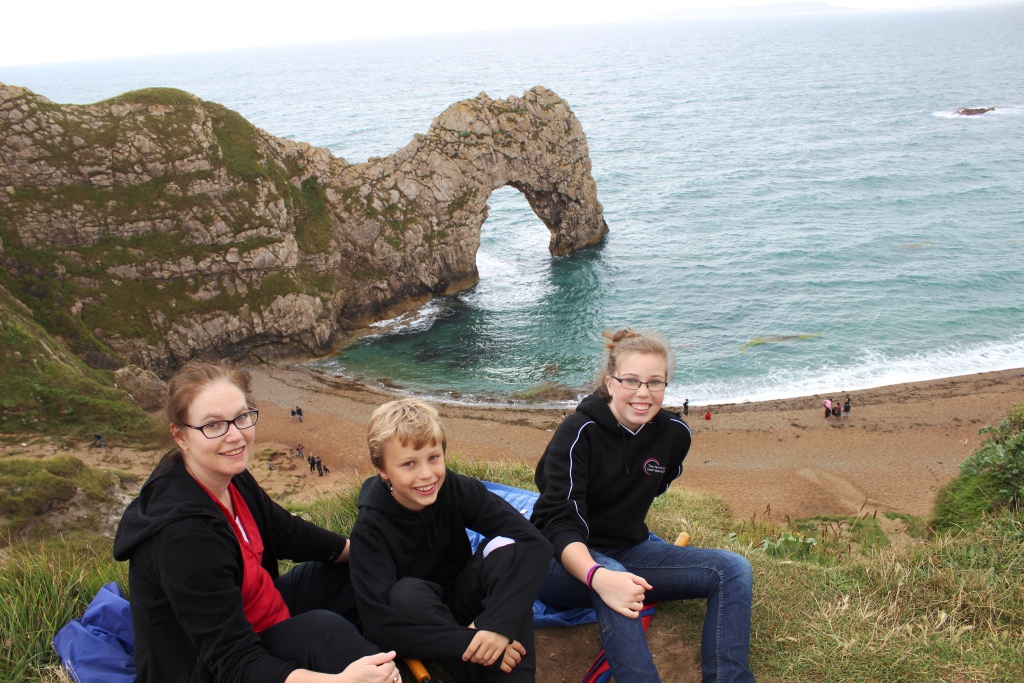
As part of this trip we also went down to the coast to have a look at the amazingly formed Lulworth Cove (a result, in part, of the action of ancient ice age glacial melt water) and nearby Durdle Door on Dorset's Jurassic coast. Along the way we passed the river piddle. Really.


Brighton.
As one of the last outings of the school holidays ( yes all this happened in the holidays months ago !!!) Mark took the kids and a friend of theirs down to Brighton by train for the day. The last time we went there, in late winter 2010, it was to see Brighton Pavilion. It was a bit chilly, as the picture below suggests.


This time it was warmer, we browsed the antique shops, wandered 'The Brighton Lanes', threw money away in the penny arcades on the pier and even went swimming !


The traditional Strutt/ Eldrdige family pavlova.
The last 'event' of the holidays was the long awaited arrival of our good friend Lyndall, who works in Iraq. She was on a much deserved rotation leave out of Baghdad and spent a few days with us enjoying the relative safety of London and some of its green and pleasant walks.

Sunday, 18 November 2012

BAKE OFF NUMBER 3

With Bake Offs 1 and 2 both drawn, it was inevitable there would be a third bake off!  And so it was that the two teams (Aisha and William v Bernard and Simon) gathered in the kitchen at Number 10 (Shakespeare Gardens!) to pit their skills.

The bake off was to provide a definitive result, so rules had been agreed to in advance:
  • independent judges to score out of 10 for both presentation and taste
  • baking in advance of the judges' arrival
  • judges not to be made aware of who had baked what until after voting

A picture of concentration.


Once Bernard and Simon arrived, work areas were defined and the baking began.  Concentration levels were high with time of the essence and judges arriving just an hour or so later. Aisha and William worked collaboratively on their lemon polenta syrup cake while Bernard and Simon created their banana macadamia honey cake.  Coincidentally both cakes went into the oven at exactly the same time so all could take a break before the judges arrived. 

Will has honey envy.
The great bakers.


The cakes!
Finishing touches are added.

Our judges had been carefully selected for the task - talented, articulate, analytical and great company was what we required and got in friends Michelle Wood, Nicole Leddicoat and Matt Black!  Before they set to their task though, we shared a yummy Indian dinner Mark had prepared around the bakers!  

Indian dinner by Mark - yum!
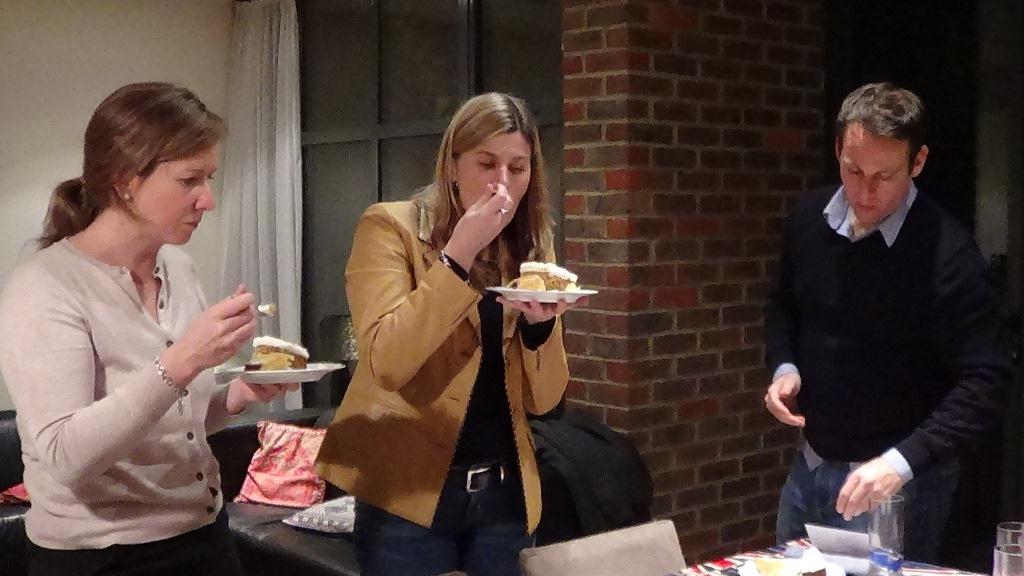
Taking their role very seriously, the judges then vacated to wait in the reception room while cakes were decorated and finishing touches made. The judges and competitors swapped places with the nervous competitors (well, actually rather self-assured) to wait while the judging took place. Sally, behind the video, impartially captured a methodical process of careful 'plating up', tasting, smelling, discussing, more tasting and finally scoring. Below are some edited highlights of the night.


 With everyone gathered, the judges delivered their individual feedback with positive comments and recommendations.

They then declared their favourite cakes - Matt and Michelle going with the lemon polenta cake and Nicole with the banana macadamia cake!!  But....when the scores were in, the final results were .......

Look at the body language !
Michelle gives her judgement.


Is Will happy with the results ?
Yes he is.


.....you'll have to look on the last video sequence, the one on its own.

Thereafter followed some discussion about the 2000 US elections when Al Gore won the popular vote but George W Bush won the election!  While Bernard came up with this observation, he then decided he was not entirely sure he liked the Bush moniker and ended up by commenting that if Mark's dinner had been judged, "he would have pulled an Obama on us all"!

As for Bake Off # 4....... it seems that there will be a rejig of the teams - Aisha and Simon have joined forces (she 'friended' him on FaceBook on the spot so they can hatch their plans), and William teams up with Bernard!!

Stay tuned...

Many thanks to bakers and judges - a great evening of fun, food and friendship!  

Wednesday, 14 November 2012

SECRETS, LEAPING, SPEED & FEATHERS.

BLETCHLEY PARK

...A few weeks later, in late August, we went to Bletchley Park, home of the WWII code breakers. Bletchley is in Milton Keynes famous for being a planned and perhaps, therefore, boring town. It certainly reminded us of Canberra! Despite being planned and built in the 1960s, the streets in residential areas were narrow and driving was still very much a game of 'duck & weave', much to Mark's disappointment.
A German Enigma machine 

It was at Bletchley Park that the most brilliant scholars and students from Oxford, Cambridge and beyond were brought to try to break the famous German Enigma cypher machine codes.  Alongside them, doing the painstaking manual work of trial and error code breaking, and using the machines developed at the park, were many young women from good homes whose loyalty to the nation was beyond reproach!  All were sworn to a lifetime of secrecy and, amazingly, Bletchley's stories have only become more widely known since the release of secret archival information in the 1970s.  There are many sad tales of people never telling their friends or families what their war time contribution had been (and being castigated/scorned for not joining up), even their own children as the years rolled on.  Indeed many passed away never having told their stories.

Lorenz
The way the Enigma machines worked and all that was involved in cracking the codes is so complex as to be only vaguely comprehensible to most people, including us! Despite that, the modern Bletchley park, which is run by enthusiastic volunteers, attracts large numbers of cipher geeks, many of whom seemed to actually understand how the code making and breaking machines worked!


Another Enigma machine used in 1944.
It was never cracked by Bletchley


The Germans believed Enigma would make communications impenetrable to the enemy. However, with the help of Polish mathematicians who had managed to acquire a machine prior to the outbreak of WW2, British code breakers stationed at Bletchley Park managed to crack the Enigma code, giving the Allies a key advantage. The intelligence produced at Bletchley Park was codenamed 'Ultra' and was crucial to the Allied war effort. It is widely considered that 'Ultra' shortened the war by two to four years, saving many lives, and that the outcome of the war could have been very different without it.

While the code breakers at Bletchley were immensely clever people, it was, we were told, a series of lucky breaks, by way of poor German code practise, that their painstaking work identified and ultimately helped them crack the codes. 


One of these code breakers was Alan Turing who played a vital role in deciphering the Enigma messages. and in developing what would become the forerunner of modern computers. He took the lead in a team that designed the 'Bombe' machine which successfully decoded German messages. He became a well-known and rather eccentric figure at Bletchley!

Made from slate
Turing was a genius. After the war, he and a former undergraduate colleague, began writing a chess program - for computers that did not exist at the time - which has since been tested and proven! Turing was also gay which, at the time, was illegal. In 1952 Turing was convicted of gross indecency which led to the withdrawal of his high level security clearance and effectively ended his career. He was given the option of either jail or 'treatment'. He opted for the latter which basically involved chemical castration. In June 1954, after two years of 'treatment' he died, most likely by his own hand. 


Turing memorial


After years of campaigning by his supporters a government apology was issued in 2009 by then Prime Minister Gordon Brown. In part, the apology said:

"....thousands of people have come together to demand justice for Alan Turing and recognition of the appalling way he was treated. While Turing was dealt with under the law of the time and we can't put the clock back, his treatment was of course utterly unfair and I am pleased to have the chance to say how deeply sorry I and we all are for what happened to him ... So on behalf of the British government, and all those who live freely thanks to Alan's work I am very proud to say: we're sorry, you deserved so much better."


The Lorenz was an even more complex cipher machine used exclusively for the most important messages passed between the German Army Field marshals and their Central High Command in Berlin. John Tiltman, another great cryptanalyst at Bletchley, broke the first messages in 1941 using hand-methods and statistical analysis, but by 1944 the Germans had introduced complications making it virtually impossible to break by hand alone. Max Newman and his team were given the task of building machines to break the codes.

The first machine designed to break the Lorenz was slow and unreliable but ‘Colossus’, a much faster and more reliable machine, was then built with the help of Tommy Flowers, a brilliant Post Office electronics engineer.  Colossus, the world’s first practical electronic digital information processing machine and a forerunner of today’s computers, could do the huge amount of mathematical work  needed in hours, rather than weeks. The first Colossus was working in time for Eisenhower and Montgomery to be sure that Hitler had swallowed the deception campaigns prior to D-Day in 1944.

Flowers, like Turing and others at Bletchley, was not recognised for his enormous contribution after the war because of the secrecy surrounding what had been done and concerns to keep others, particularly the Russians as the Cold War developed, from knowing Britain's code breaking capability.


SKY-DIVING!!

No doubt Bletchely Park (LINK) was enormously fascinating for the kids..... but we had also built our Milton Keynes trip around another 'kid surprise'!

Despite its reputation as being possibly not the most exciting of places, Mark had found an indoor skydiving centre there!! Basically it is a huge blower in an enclosed chamber with a wind tunnel speed of about 150km. Although the time spent skydiving was very short it seemed the kids enjoyed it a lot. Whether Mark actually enjoyed it remains to be decided. Sally opted out completely!

The video below shows a little of what the kids did as well as the instructor showing just what is possible after lots of 'air ' time.


Hmmmmmm.


SPEED DEMONS

Back in London, Mark took the kids and a couple of their friends go- karting. While it was not the best track they have been on( their first track in Denmark probably takes that title. click here and scroll down to see their first karting.) they still had fun.


BIG WALK

Towards the end of the holidays we decided to replicate a walk that Sally did a year earlier from her work on the Strand back to East Finchley. It took just over 2 hours and helped give us a different perspective of the city we call home. 


FEATHERS, FEATHERS EVERYWHERE

As part of the Olympic/Paralympic festivities, London put on a large number of amazing and fun activities. We stumbled across this one (hats on iconic figures) after going to a west end performance of the Monty Python inspired 'Spamalot' (hilarious). 

Patriotic Nelson
After collaring one of the leads, Jon Culshaw of Dead Ringers and Tony Blair impersonations fame....  
and having dinner, we were walking towards Leicester Square to take the tube home but ended up following the sound of music to Picadilly Circus, where we found a growing crowd watching some inflatable characters and high wire performers. It all seemed fairly interesting but then some of the performers started to throw feathers around. Soon industrial air blowers were turned on and the amount of feathers grew and grew and grew and just kept on growing! Feathers blew around for nearly 20 minutes. The joyous reaction of the crowds was as if it were snow and, in fact, it was almost like snow as in the end there were 1.5 tonnes of feathers laying ankle deep for several city blocks. Once the feather blowers had stopped the crowds then had 'feather fights' and continued the celebration. The street sweepers who were poised to move in once the crowd had left certainly had a big job ahead of them. It was one of the most incredible events we have been a part of.  


In the next overdue post .....
  • a summer festival with a little bit of Rio coming to London. 
  • we all go to BrownSea island
  • Mark and kids go to Brighton
  • a visitor from Baghdad